Last updated: July 14, 2026
12-Season vs 4-Season Colour Analysis: What's the Difference?
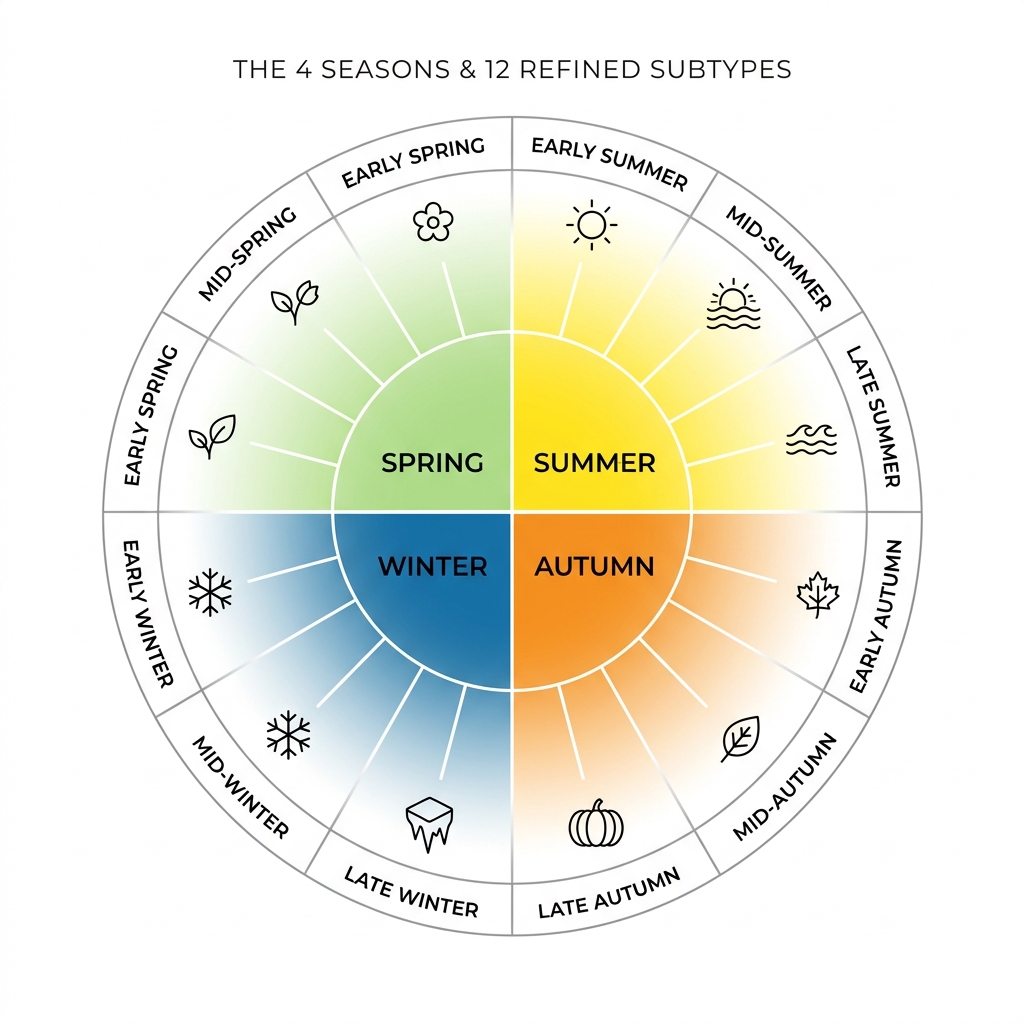
Quick answer: The 4-season system groups people into Spring, Summer, Autumn, or Winter based on undertone and general brightness. The 12-season system takes those same four groups and splits each one further by depth and clarity, giving a more precise (but more complex) result. Both are built on the same underlying colour theory — 12-season is simply a more detailed version of 4-season, not a competing idea.
Where Both Systems Come From
Seasonal colour analysis started as a 4-season model in the early 1980s, grouping people by undertone and brightness into the four seasonal names. As the method grew more popular with professional stylists, practitioners found that some people didn't fit neatly into just four boxes — leading to the 12-season expansion, which adds depth and clarity as extra dimensions within each season.
The Comparison
| 4-Season | 12-Season | |
|---|---|---|
| Basis | Undertone + general brightness | Undertone + depth + clarity |
| Precision | Broad, easier starting point | More precise, fewer "close but not quite" matches |
| Best for | Quick, general shopping guidance | Fine-tuning a wardrobe, building a full palette |
| Complexity | Simple to understand and remember | Takes more explanation, easy to overthink |
Which One Should You Actually Use?
For everyday shopping decisions, the 4-season basics (your undertone plus roughly how bright or muted you should go) already get you 80% of the way to good choices. The 12-season refinement mostly matters when you're building out a full, precise wardrobe or when your traits sit right on the edge between two groups.
Do You Need to Know Your Exact Season Name?
Not really — what actually changes your shopping and styling decisions is knowing your undertone, depth, and clarity in plain terms. The specific season label (whether it's "Warm Autumn" in the 12-season system or just "Autumn" in the 4-season one) is a convenient shorthand, not something you need memorised to dress well.
FAQ
Which system is more accurate?
Neither is "more correct" — 12-season is more granular, which helps with borderline cases, but both are built on the same core undertone and contrast principles.
Can I get good results using just the 4-season basics?
Yes, for most everyday shopping. The extra precision of 12-season mainly helps when you're right on the edge between two groups or building a very deliberate, complete wardrobe.
Does Colourity use the 12-season system?
Colourity's AI analyses undertone, depth, and clarity behind the scenes for precision, but it translates the result into plain, everyday colour language rather than a season label — so you get 12-season-level accuracy without needing to learn the terminology.
Skip memorising season names entirely — [Colourity tells you your exact colours in plain language →](https://colourity.com)