Last updated: July 17, 2026
Anarkali Colours by Skin Tone: The Complete Indian Guide (Fair to Dusky)
Quick answer: The wrong anarkali colour doesn't just look off — the floor-length silhouette magnifies the clash. Royal blue and emerald green work across almost all Indian skin tones. But if you want to be precise, match your undertone first: warm undertones glow in mustard, rust, and maroon; cool undertones shine in sapphire, plum, and berry.
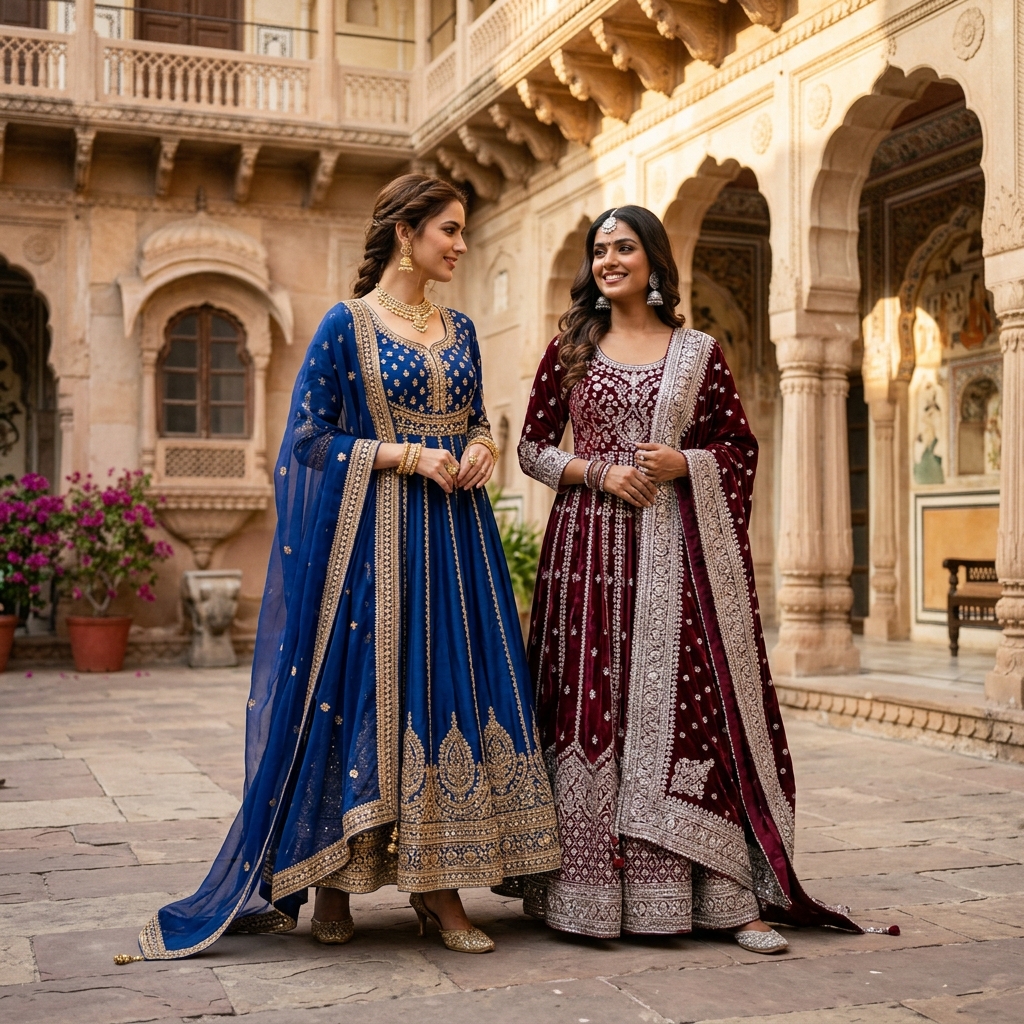
Why Anarkali Colour Choice Matters More Than Other Garments
The anarkali silhouette is unlike any other Indian garment. Its floor-length flare draws the eye from face to hem in one continuous line — which means the colour you choose frames your face for longer than a kurta or saree blouse would.
A poorly chosen shade on an anarkali doesn't just look slightly off. It actively competes with your complexion, either draining warmth from your face or creating a jarring visual break.
Get it right, and the anarkali becomes the most flattering garment you own.
Understanding Your Starting Point
Before the colour chart, two things to establish:
Your skin depth:
- Fair — Light skin that may have pink, peach, or golden undertones
- Wheatish/Medium — The most common Indian skin tone — ranges from golden-olive to cool wheat
- Dusky — Deeper, richer complexion with warm brown or cool-neutral undertones
Your undertone:
- Warm — Greenish veins, gold jewellery looks better, skin has yellow/golden/olive cast
- Cool — Blue/purple veins, silver jewellery looks better, skin has pink/rosy cast
- Neutral — Mix of both, or can't tell; both silver and gold work equally
Anarkali Colours for Fair Skin Tones
Fair skin in India often has one of two undertone profiles: rosy-pink (cool) or golden-peachy (warm). Both need different shade strategies.
Fair Skin — Warm Undertones (peach, golden, peachy-pink)
Best anarkali colours:
| Colour | Shade to Choose | Why |
|---|---|---|
| Peach / Coral | Soft coral or warm peach | Harmonises with golden undertones — looks luminous |
| Mustard | Pale mustard or golden yellow | Warm yellow base complements warm fair skin perfectly |
| Terracotta | Light terracotta or rust pink | Earthy warmth enhances the golden quality of warm fair skin |
| Ivory / Cream | Ivory (not stark white) | Warm white creates an ethereal, soft glow |
| Burgundy | Wine or deep berry | A rich warm red adds depth without clashing |
Avoid: Icy blue, cool lavender, stark white, neon shades — all neutralise the warmth that makes this skin tone beautiful.
Fair Skin — Cool Undertones (pink, rosy, pinkish-beige)
Best anarkali colours:
| Colour | Shade to Choose | Why |
|---|---|---|
| Royal Blue | Sapphire or icy periwinkle | Cool blue harmonises with pink-cool undertones |
| Plum / Purple | Soft lavender to deep plum | Any purple works — cool undertones are tailor-made for this |
| Berry Pink | Raspberry or fuchsia | Cool pinks look vivid and fresh against fair cool skin |
| Emerald Green | Jewel-toned emerald | Cool-leaning green creates sophisticated contrast |
| Navy | Classic navy or midnight blue | Deep cool neutrals are endlessly flattering |
Avoid: Warm oranges, mustard yellow, terracotta — these fight against the pink in your skin.
Anarkali Colours for Wheatish/Medium Skin Tones
Wheatish skin is India's most common complexion, and it's incredibly versatile. Most jewel tones look stunning on it. The key is steering toward the warm or cool side of the spectrum based on your undertone.
Wheatish Skin — Warm Undertones (golden-olive, honey, yellow-brown)
Best anarkali colours:
| Colour | Shade to Choose | Why |
|---|---|---|
| Mustard | Deep mustard or turmeric | The gold base sings against warm wheatish — classic and timeless |
| Rust / Burnt Orange | Deep rust or burnt sienna | Earthy warmth amplifies the natural richness of warm skin |
| Maroon | Deep wine or maroon | Warm reds are consistently the most photographed colour on warm wheatish |
| Forest Green | Olive or hunter green | Earthy greens honour the olive quality of warm wheatish skin |
| Coral | Warm coral or terracotta | Sunset-adjacent shades look warm and alive |
Avoid: Cool lavender, icy blue, cool greys — they strip warmth and make skin look flat.
Wheatish Skin — Cool Undertones (pinkish-wheat, cool beige, ash-brown)
Best anarkali colours:
| Colour | Shade to Choose | Why |
|---|---|---|
| Royal Blue | Cobalt or royal blue | Cool blue is electrifying against cool wheatish undertones |
| Emerald | Jewel emerald or teal | Cool-leaning jewel tones look exceptionally regal |
| Plum / Orchid | Deep plum or bright orchid | Cooler purples are strikingly flattering |
| Dusty Rose | Mauve or rose quartz | Soft cool pinks look effortlessly elegant |
| Crimson / Cherry | Cool-based red | Reds with a blue undertone look sharp, not muddy |
Avoid: Very warm oranges, earthy ochres — these can look slightly off against cool-toned skin.
Anarkali Colours for Dusky/Deep Skin Tones
Deep Indian skin has a natural richness that benefits most from bold, saturated shades. Muted or pale colours tend to disappear — so the rule of thumb is: the more saturated, the better.
| Colour | Best Shade | Why |
|---|---|---|
| Electric Blue | Bright cobalt or electric | Maximum contrast creates a showstopper look |
| Hot Pink / Magenta | Bold fuchsia or deep rose | Saturated pinks are electrifying on deep Indian skin |
| Emerald Green | Deep jewel emerald | Rich green creates a regal, luminous contrast |
| Gold / Bronze | Deep metallic gold | Metallics mirror the warmth in deep skin beautifully |
| Bright Yellow | Deep marigold or saffron | Rich yellows glow against deep complexions |
| White | Pure white (be bold) | High contrast white on deep skin = stunning |
| Crimson / Scarlet | Saturated red | Deep reds look absolutely powerful |
Avoid: Very light pastels (baby pink, powder blue, mint) — these shades get visually lost against deep skin.
The Dupatta Colour Rule
The dupatta is your most powerful colour tool in an anarkali. Use it for contrast, not matching.
| Anarkali Colour | Best Dupatta Contrast |
|---|---|
| Royal Blue | Gold, ivory, or silver |
| Mustard Yellow | Burgundy, emerald, or ivory |
| Emerald Green | Coral, gold, or ivory |
| Maroon / Burgundy | Ivory, gold, or forest green |
| Coral | Ivory, emerald, or navy |
| White / Ivory | Any jewel tone (go bold) |
Rule: Your dupatta should be at least 2–3 shades away from the anarkali on the colour wheel. A matching dupatta collapses the visual interest of the entire outfit.
How Fabric Changes Colour Perception on Indian Skin
This is rarely discussed — but fabric texture dramatically changes how a colour reads on your skin.
| Fabric | How It Changes Colour |
|---|---|
| Georgette | Softens colour slightly — good for intense jewel tones you want to wear with less drama |
| Net / Sheer | Lightens any colour — add 1 shade darker than your intended colour when choosing |
| Velvet | Deepens colour and adds richness — ideal for fair and wheatish skin wanting more depth |
| Silk | Adds luminosity — cool tones look more vivid; warm tones look more golden |
| Rayon / Viscose | Neutral carrier — colour appears closest to how it looks on paper |
Practical tip: If you're buying fabric rather than a readymade, hold the bolt under your chin in daylight. The answer is immediate — you'll either glow or look drained.
Occasion-Based Colour Recommendations
| Occasion | Recommended Anarkali Colours |
|---|---|
| Wedding (as guest) | Deep jewel tones — sapphire, emerald, plum, maroon |
| Eid / Festive | Bright saturated shades — fuchsia, turquoise, gold |
| Casual / Daytime | Mid-toned shades — dusty rose, olive, teal, coral |
| Office / Semi-formal | Muted jewel tones — steel blue, wine, forest green |
| Evening / Party | Bold metallics or deep saturated shades |
Frequently Asked Questions
Q: What's the most universally flattering anarkali colour for Indian skin?
Emerald green. It works across fair, wheatish, and dusky skin, and across warm and cool undertones. If you're buying one anarkali without knowing your undertone, choose emerald.
Q: Can a dusky-skinned woman wear pastels in an anarkali?
Yes — but go for saturated pastels, not pale ones. Deep mauve, warm dusty rose, and rich sage are "pastels" that carry enough chroma to read beautifully on deeper skin.
Q: How do I know if an undertone is warm or cool?
Check your veins in natural daylight. Greenish = warm. Blue/purple = cool. Both = neutral.
Q: Should my blouse match or contrast the anarkali?
For a traditional look, match within the same colour family (2 shades lighter or darker). For a modern editorial look, contrast boldly — a burgundy anarkali with a gold blouse is stunning.
Q: Does body type affect which anarkali colour to choose?
Colour doesn't change body shape — but contrast does create focal points. If you want to draw attention upward, choose your most vibrant colour for the blouse, a mid-tone for the skirt.
Find Your Exact Colour Palette
Every recommendation above is based on general skin-tone categories. Your exact complexion is unique — it has a specific undertone, depth, and clarity that no chart can fully capture.
The [Colourity app](https://colourity.com) analyses your face using AI to identify your personal colour season and generate a precise colour palette for your exact skin. No more guessing which shade of blue actually works for you — just scan and get your answer.